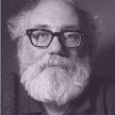
Giancarlo De Carlo was born in Genoa, Liguria, in 1919. In 1939 he enrolled at the Milan Polytechnic, where he graduated in engineering in 1943. During the Second World War he was enlisted as a naval officer. Following the armistice of 8 September 1943 he went into hiding, taking part in the Italian Resistance with the Movement of Proletarian Unity in which other Milanese architects such as Franco Albini also participated. Later he organized an anarchist-libertarian partisan group in Milan (the Matteotti Brigades), together with Giuseppe Pagano.
At the end of the war he publicized Le Corbusier in Milan and joined the anarchist movement, eventually participating in the first congress of the International of Anarchist Federations in Carrara. In this period, he began his collaboration with the anarchist magazine Volontà, in which he tried to launch new social ideas for reconstruction and the incessant need for social housing.
In 1948, he resumed his studies at the Istituto Universitario di Architettura di Venezia (Università Iuav di Venezia) where he received his degree in architecture on 1 August of the following year (1949).
In 1950 he opened his own studio in Milan. In 1951 he organized an exhibition on spontaneous architecture and, three years later, presented three short films written with Elio Vittorini in which he denounced the drift towards a modern metropolis run by bureaucrats and technicians, in whom interest in man is not a priority, and urged the spectator to act personally.
In 1955 he obtained a professorship in urban planning which he maintained until 1983, coming into contact and often clashing with the major names in Italian architecture and urbanism such as Giuseppe Samonà, Carlo Scarpa, Bruno Zevi and Paolo Portoghesi. Between 1952 and 1960 he was part of the new generation invited to participate in the Congrès Internationaux d’Architecture Moderne (CIAM).
In 1956, as an Italian member of the CIAM, he presented his own project for a housing complex in Matera in which all the principles of le Corbusier are ignored at the expense of specific attention to the geographical, social and climatic context of the region. It is clearly a strong break with the old generation of architects and the myth of a unique international architectural model. Thus, in the 1956 congress, the end of the CIAM was marked with the start of Team 10, which brought together the new generation of architects (including De Carlo, Alison and Peter Smithson, Aldo van Eyck, and Jacob Bakema) to conceive a new type of architecture, one which was better suited to local social and environmental conditions and where man “is not reduced to an abstract figure”.
In 1964 he was in charge of the first General Town Plan of the city of Urbino. Since 1965 he was in charge of designing the campus and facilities of the new University of Urbino. In the project the campus merges with the landscape, physically fitting into the hills. It was this project that saw him busy for many years of his life, and that gave him his first real international recognition.
From 1970, he is invited to teach in the united states and draws numerous editorial and professional impulses from this experience. He began building houses for workers in Terni, together with the workers and their families themselves. This was the first example of a participatory architecture in Italy, which turned out to be a success, being repeated with different results and procedures; in 1972 for the Rimini City Plan, and in 1979 for the recovery of Mazzorbo island in Venice.
In 1976 he founded the ILAUD (International Laboratory of Architecture & Urban Design), based on the principles of Team X, which for 27 years took place every summer in Italy, in order to carry out continuous research in the evolution of architecture.
In 1978 he founded and directed the magazine “Space and society” through which for more than twenty years he kept the network created by Team X active and guaranteed an alternative and independent voice in the European architectural sphere.
De Carlo died in Milan in 2005.